Queer Virtue by Elizabeth M Edman
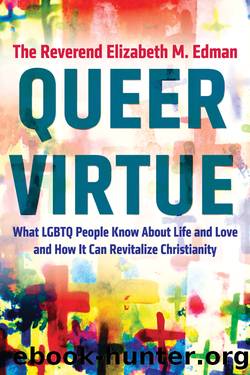
Author:Elizabeth M Edman [Edman, Elizabeth M]
Language: eng
Format: epub
ISBN: 9780807061350
Publisher: Beacon Press
Published: 2016-02-15T05:00:00+00:00
CHAPTER 6
ADOPTION
When I came into the bar in drag, kind of hunched over, they told me, âBe proud of what you are,â and then they adjusted my tie.
âLESLIE FEINBERG, Stone Butch Blues
Have you ever read a book that changed your understanding of yourself, of your place in the world? Thatâs what Leslie Feinbergâs Stone Butch Blues did for me. A fictional memoir of one butchâs life from the late 1940s through the 1980s, the story rocks back and forth from brutal accounts of raids and bashings to extraordinary moments of courage and tenderness.
The book challenged me to look at my own prejudice. Coming out in the 1980s, I inherited an arrogant disdain for butch/femme culture. It was common then for white lesbians who were involved in the feminist movement to disparage what we perceived as an aping of the oppressive heterosexual gender roles that we sought to escape. Ours was a shame-filled response, the result of having been similarly disparaged by mainstream feminism in the 1970s. Feinbergâs book put human faces on what to me had been merely labels.
I was surprised just how much of myself I saw in her characters, in their need of each other, in their determination to survive with as much integrity as they could muster. The world they inhabited was the one I would have inhabited if Iâd been born twenty years earlier; the bars that were home for them would have been mine, too. Feinbergâs book was a gift, a legacy. I read it and felt claimed by people I desperately wished to claim back.
In 1993 Feinberg held a reading at Judithâs Room, a womenâs bookstore in the West Village. I had to go. I just wanted to be in the same room with her. After the reading, I had to stoke my courage to go up to her. I think I was trembling as I reached out to shake her hand. She looked me right in the eye, generously encouraging me. âThank you for writing this book,â I said. âI didnât . . . I didnât know . . .â I struggled to get the words out. âI didnât know that we were a people, with a history.â She thanked me, and I turned to go. When I hit the sidewalk, tears spilled. I stood there for what seemed a long time, crying, shaking, caught up in an experience that I knew I would remember the rest of my life.
Leslie Feinberg gave me one of the most important gifts that one gets from community. It is the same gift that the butches in the bars taught her protagonist, Jess, as they lovingly straightened her tie: the knowledge of self that comes from belonging to others.
âWe see you. We value you. You are a part of us.â
These messages are bedrock for other messages that are crucial to a healthy conception of self: âKnow who you are. Be who you are. Be proud of who you are.â
Queer identity may be discerned in relative isolation, but it comes to life in community.
Download
This site does not store any files on its server. We only index and link to content provided by other sites. Please contact the content providers to delete copyright contents if any and email us, we'll remove relevant links or contents immediately.
Cecilia; Or, Memoirs of an Heiress — Volume 1 by Fanny Burney(32559)
The Great Music City by Andrea Baker(32020)
Cecilia; Or, Memoirs of an Heiress — Volume 2 by Fanny Burney(31957)
Cecilia; Or, Memoirs of an Heiress — Volume 3 by Fanny Burney(31943)
We're Going to Need More Wine by Gabrielle Union(19049)
All the Missing Girls by Megan Miranda(16033)
Pimp by Iceberg Slim(14513)
For the Love of Europe by Rick Steves(14138)
Bombshells: Glamour Girls of a Lifetime by Sullivan Steve(14077)
Talking to Strangers by Malcolm Gladwell(13374)
Norse Mythology by Gaiman Neil(13371)
Fifty Shades Freed by E L James(13244)
Mindhunter: Inside the FBI's Elite Serial Crime Unit by John E. Douglas & Mark Olshaker(9345)
Crazy Rich Asians by Kevin Kwan(9293)
The Lost Art of Listening by Michael P. Nichols(7507)
Enlightenment Now: The Case for Reason, Science, Humanism, and Progress by Steven Pinker(7315)
The Four Agreements by Don Miguel Ruiz(6766)
Bad Blood by John Carreyrou(6623)
Weapons of Math Destruction by Cathy O'Neil(6282)
